
North America stands apart from every other global region in its relationship with Middle East conflict — it is simultaneously the world’s largest military and diplomatic participant in regional stabilization efforts, the world’s largest oil and gas producer capable of supplying global alternatives, and a continent whose largest economy benefits from safe-haven capital flows when global risk sentiment deteriorates. The net effect is complex and sector-specific, but broadly: the United States is a net winner from elevated oil prices, and the conflict is accelerating American strategic interests in energy independence, defense, and geopolitical realignment.
Executive Summary
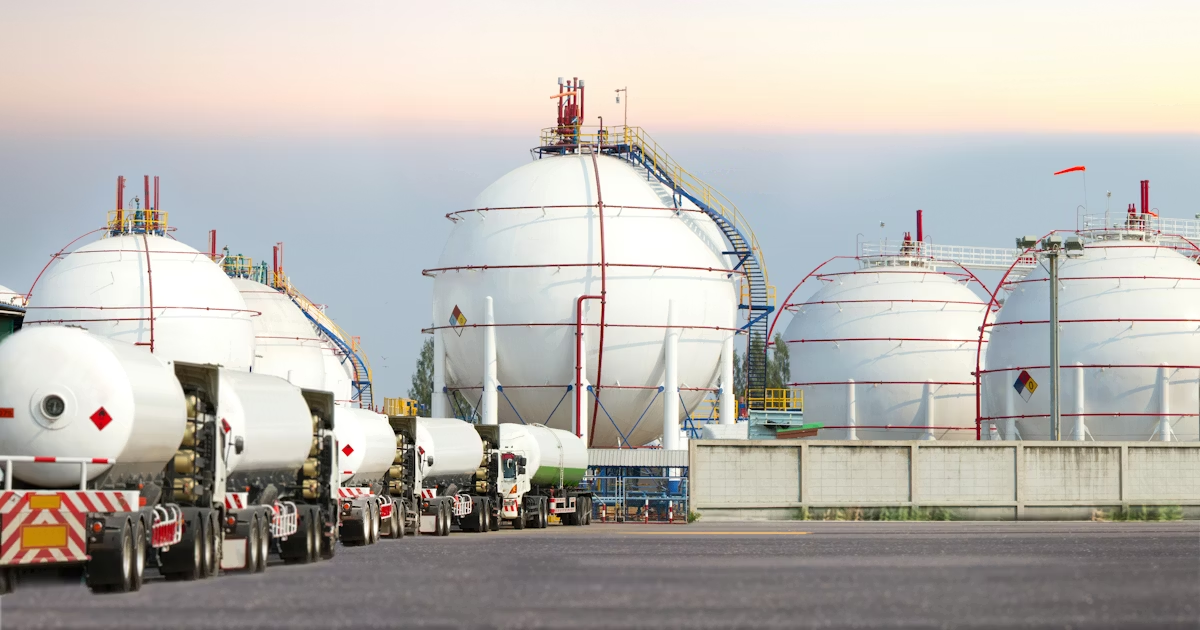
The United States achieved a historic milestone in becoming a net energy exporter in 2019 and has maintained that status through disciplined shale production management and expanded LNG export infrastructure. With Brent crude sustained above $90 per barrel, US domestic producers — ExxonMobil, Chevron, ConocoPhillips, Pioneer, and the broader shale independent sector — are recording strong free cash flows and capital return programs. The conflict has also re-energized arguments for expanding US LNG export capacity to serve European and Asian allies seeking to reduce Middle East dependence.
Canada, as a major oil sands producer and pipeline exporter to the US, similarly benefits from elevated oil prices, though the country’s export infrastructure constraints (pipeline capacity, ocean access) limit its ability to rapidly increase volumes into global markets. Mexico’s state energy company Pemex, despite operational challenges, is benefiting from elevated crude prices as it manages its heavy debt burden.
The defense sector impact is unambiguous and strongly positive. US defense contractors — Lockheed Martin, RTX (formerly Raytheon), Northrop Grumman, General Dynamics, L3Harris — are operating with record backlogs as global rearmament demand accelerates. The conflict has also renewed domestic political appetite for US energy and defense industrial investment, creating legislative tailwinds for expanded production capacity.
Energy Sector: America’s Structural Advantage
Shale Production and Global Supply Rebalancing
US shale producers have responded to elevated oil prices with measured production increases constrained by investor demands for capital discipline over volume growth. The Permian Basin — the world’s most productive oilfield — continues to operate with remarkable efficiency, with producers routinely achieving breakeven costs below $45/barrel, generating extraordinary free cash flows at $90+ Brent. However, rig count growth has been modest compared to previous price up cycles, reflecting a sector prioritizing shareholder returns over production maximization.
The US LNG export sector has emerged as a critical strategic asset. With the Biden and subsequent Trump administration both pursuing aggressive LNG expansion, US export capacity has grown significantly. American LNG producers — Chenier Energy, Venture Global, Sempra — are signing long-term supply agreements with European and Asian buyers seeking to replace Middle East dependency. New export facilities along the Gulf Coast are under active construction, with completion schedules tightened in response to geopolitically-driven demand urgency.
Sector-by-Sector Market Impact
| Sector | Impact | Market Outlook |
| Oil & Gas (Production) | Brent $90+ generates record upstream free cash flow | Strongly Positive — majors and shale independents |
| LNG Export | European/Asian demand surging; new capacity fast-tracked | Strongly Positive — Cheniere, Venture Global, Sempra |
| Defence & Aerospace | NATO rearmament, Israeli procurement, global demand surge | Strongly Positive — LMT, RTX, NOC, GD, LHX |
| Airlines & Aviation | Jet fuel cost inflation; Middle East route disruptions | Negative — hedging programs tested |
| Consumer Goods (Retail) | Import cost inflation via shipping disruption; supply chain | Moderate Negative — inventory build cycle extending |
| Agricultural Exports | US ag exports face higher freight costs; competitive issues | Mixed — elevated grain prices partially offset costs |
| Financial Markets | Risk-off triggers safe-haven USD strength; Treasury demand | Positive for USD; mixed for equities |
| Technology Sector | Defense-tech, cyber security boom; semiconductor supply risk | Mixed — pure tech vulnerable; cyber stocks surging |
Defense: The Most Direct Beneficiary
No sector has benefited more from the sustained Middle East conflict environment than the US defence industry. The combination of direct US military operations and support in the region, NATO allies’ accelerated rearmament programmes, Israeli defence procurement, and emerging concerns about Taiwan Strait stability has created a demand environment that US defence contractors struggle to match with production capacity.
Lockheed Martin’s F-35 programme alone has a backlog spanning multiple years. RTX’s Patriot air defence system — the gold standard of missile defence that has seen direct deployment in multiple theatres — is oversubscribed. General Dynamics’ land systems division is producing M1 Abrams tanks and Bradley Fighting Vehicles at rates not seen since the Cold War. The US defence industrial base is, for the first time in two decades, facing genuine production capacity constraints rather than demand constraints.
The Pentagon’s fiscal year 2026 budget of approximately $895 billion represents the largest defence allocation in American history in nominal terms. Congressional support — rare in its bipartisan breadth — has focused on restoring munitions stockpiles drawn down by Middle East and Ukraine support operations, investing in next-generation capabilities including hypersonic missiles, directed energy systems, and autonomous platforms, and strengthening the industrial base through reshoring of critical component manufacturing.
“America’s energy independence, achieved through a decade of shale innovation, has transformed the geopolitical calculus of Middle East conflict from a vulnerability to a strategic asset. The United States can now approach regional instability from a position of energy security that was unimaginable twenty years ago.”
— Goldman Sachs Global Investment Research, US Energy Independence Monitor, 2026
Investment Outlook and Market Strategy
US equity markets have broadly outperformed global peers during the current period of Middle East instability, driven by the energy sector’s strong performance, defence sector earnings momentum, and the dollar’s safe-haven strengthening. The S&P 500 Energy sector has outperformed the broader index by approximately 18% since the conflict intensified in late 2024, while the defence/aerospace sub-sector has added approximately 25% in market capitalisation over the same period.
Fixed income markets have seen increased demand for US Treasuries as risk-off sentiment drives global capital toward the world’s safest sovereign debt. The Federal Reserve is navigating a complex environment where geopolitically-driven energy inflation argues against rate cuts while slowing global trade growth argues for maintaining accommodative policy. The outcome of this tension will be a key driver of US and global financial market direction in 2026.
Strategic Recommendations for North American Businesses
- Position in defence supply chains: even non-traditional suppliers can find opportunities providing raw materials, advanced manufacturing, or technology services to prime contractors
- Capitalise on LNG export expansion: infrastructure, engineering, and technology firms serving the LNG export build-out are well-positioned through 2028
- Assess nearshoring opportunities: companies with Asian supply chains should quantify the risk-adjusted business case for Mexico or Central America manufacturing relocation
- Monitor cybersecurity spending: Middle East cyber threat activity is creating sustained enterprise and government cybersecurity demand — a structural rather than cyclical opportunity
- Hedge USD exposure: USD safe-haven strengthening compresses international revenue for US multinationals — active FX hedging programs are advisable